
Core Competencies in Research
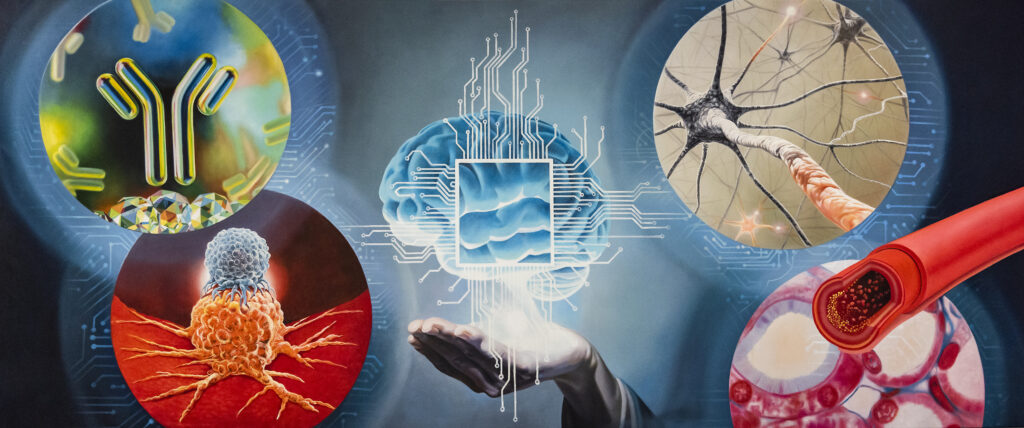
The landscape of university medicine in Erlangen is defined by five research focus areas.
Translational research is achieved through a close interdisciplinary connection between fundamental disciplines and clinical fields. Cross-disciplinary collaborative projects contribute to top-tier medical care.
Key aspects
This research area focuses on infection biology and immunological defense, inflammatory mechanisms, as well as autoimmunity and transplantation immunology.
Research networks and graduate programs with federal and state funding
- SFB 1755: „CASCAID – Cellular and Systems Control of Autoimmune Disease“
- SFB/TRR 241: „Immun-Epitheliale Signalwege bei chronisch entzündlichen Darmerkrankungen“
- SFB/TRR 369: „DIONE – Entzündungsbedingte Knochendegeneration“
- FOR 2886: „PANDORA – Pathways triggering AutoimmuNity and Defining Onset of early Rheumatoid Arthritis“
- GRK 2504: „Neue antivirale Strategien: von der Chemotherapie bis zur Immunintervention“
- GRK 2599: „FAIR – Feinabstimmung der adaptiven Immunantwort“
- GRK 2740: „Immunomicrotope: Mikroumgebungsbedingte, metabolische und mikrobielle Signale zur Regulation der Immunzell-Pathogen-Interaktion“
Research centers and infrastructures
Speakers
Prof. Dr. Aline Bozec
Professorship for Experimental Immunotherapy
Contact
Prof. Dr. David Vöhringer
Professorship for Infection Defense and Tolerance
Contact
Key aspects
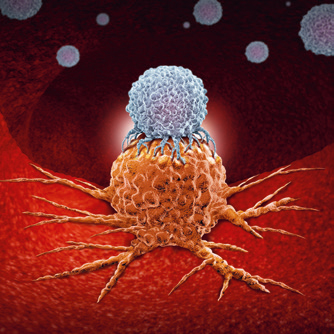
In Erlangen, tumor research primarily focuses on the following types of cancer: breast cancer, leukemias and lymphomas, lung cancer, melanoma, renal cell carcinoma, pancreatic carcinoma, and colorectal carcinoma. The research centers on tumor immunology and the interaction of the tumor with its environment. There is particularly outstanding expertise in the field of immunotherapy. The research’s leading position and its rapid translation into therapy and diagnostics are underscored by the Comprehensive Cancer Center Erlangen-European Metropolitan Region Nuremberg (CCC ER-EMN), which is certified according to the criteria of the German Cancer Society.
Research networks and graduate programs with federal and state funding
- SFB/TRR 417: “Zelluläre Kommunikation im Stroma von kolorektalen Karzinomen: von der Pathophysiologie bis zur klinischen Translation”
- SFB/TRR 221: “Modulation der Transplantat-gegen-Wirt- und Transplantat-gegen-Leukämie- Immunreaktionen nach allogener hämatopoetischer Stammzelltransplantation”
- SFB/TRR 305: “Über die Analyse der metastatischen Koloniebildung zu neuen systemischen Krebstherapien”
- SFB/TRR 643: “Dendritische Zellen zur Therapie des Uveamelanoms in Phase-I- und Phase-III-Studien”
- DigiOnko: The project “DigiOnko“ improves the prevention and treatment of breast cancer and increases the quality of life of affected women.
- ONCOnnect: Most cancer patients in Germany are treated outside of Comprehensive Cancer Centers (CCCs). Outreach networks of the CCCs are intended to ensure local access to specialized services; however, they face significant challenges, particularly in rural areas. The national collaborative project ONCOnnect bundles the expertise of all 14 CCCs, the National Cancer Prevention Center, and patient advocacy groups to strengthen regional networking and improve cancer care nationwide.
Centers and research infrastructure
- Comprehensive Cancer Center Erlangen-EMN (CCC ER-EMN)
- CCC Allianz WERA
- NCT WERA
- Bavarian Cancer Research Center (BZKF)
Speakers
Prof. Dr. Marianne Pavel
Professorship for Endocrinology
Contact
Prof. Dr. Markus Metzler
Professorship for Pediatrics focusing on Pediatric Oncology and Hematology
Contact
Key aspects
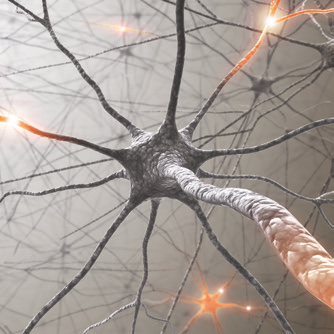
In Erlangen, experimental and clinical neuroscience, particularly focus on topics ranging from stimulus transmission, neural signal transmission mechanisms, sensory perception, to stimulus processing and perception in pain research. The field of sensory perception is particularly reflected in glaucoma research.
Research networks and graduate programs with federal and state funding
- KFO 5024: “Immun-Checkpoints der Kommunikation zwischen Darm und Gehirn bei entzündlichen und neurodegenerativen Erkrankungen”
- SFB 1540: “EBM – Erforschung der Mechanik des Gehirns: Verständnis, Engineering und Nutzung mechanischer Eigenschaften und Signale in der Entwicklung, Physiologie und Pathologie des zentralen Nervensystems”
- GRK 2162: “Entwicklung und Vulnerabilität des Zentralnervensystems”
Research centers and infrastructures
- Interdisciplinary Center for Public Health (IZPH)
- Max Planck Institute for the Science of Light (MPL)
- Max-Planck-Zentrum für Physik und Medizin (MPZPM)
Speakers
Prof. Dr. Veit Rothhammer
Professorship for Neuroimmunology
Contact
Prof. Dr. Marisa Karow-Falk
Professorship for Biochemistry and Molecular Neuroscience
Contact
Key aspects
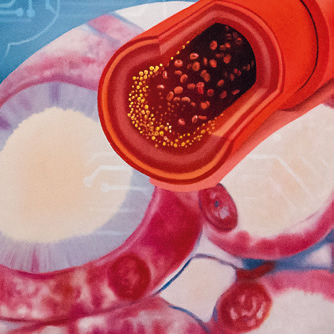
Due to their often chronic course, kidney and circulatory diseases not only affect large numbers of patients, they also cause high socioeconomic follow-up costs. At the same time, the early diagnosis of risk factors offers a great opportunity for effective prevention and the elucidation of regenerative mechanisms offers the chance of earlier rehabilitation after disease.
Research networks and graduate programs with federal and state funding
- SFB/TRR 374: “Tubular System and Interstitium of the Kidney”
- SFB/TRR 225: “Von den Grundlagen der Biofabrikation zu funktionalen Gewebemodellen”
Research centers and infrastructures
- German Chronic Kidney Disease (GCKD) Study
- Clinical Research Center for Hypertension and Vascular Medicine
- Center for Rare Kidney Diseases
- Transplant Center Erlangen-Nürnberg
- Digital Research after Kidney Transplantation (smart NTx, PCOR-MII, Smart&Fit für die Nierentransplantation)
Speakers
Prof. Dr. Mario Schiffer
Chair of Internal Medicine IV
Contact
Prof. Dr. Kerstin Ute Amann
Professorship for Nephropathology
Contact
Key aspects

The experimental developments and clinical applications pursued in medical technology not only radiate from the Medical Faculty into the Faculty of Technology and Natural Sciences, but are also excellently linked to the industrial focus on medical technology in the Erlangen area. In particular, the topics of ophthalmology, imaging diagnostics, horizontal innovations, intelligent sensor technology and therapy systems are strongly represented in Erlangen.
Research networks and graduate programs with federal and state funding
- FOR 5534: “Schnelle Kartierung von quantitativen MR-bio-Signaturen bei ultra-hohen Magnetfeldstärken”
- SFB 1483: “Empathokinästhetische Sensorik – Sensortechniken und Datenanalyseverfahren zur empathokinästhetischen Modellbildung und Zustandsbestimmung”
- SFB/TRR 225: “Von den Grundlagen der Biofabrikation zu funktionalen Gewebemodellen”
European projects
- EIT Health
Centers and research infrastructure
- Department Artificial Intelligence in Biomedical Engineering (AIBE)
- Medical Informatics in Research and Care in University Medicine (MIRACUM)
Speakers
Prof. Dr. Arnd Dörfler
Chair of Neuroradiology
Contact
Prof. Dr. Sarina Müller
Chair of Otorhinolaryngology
Contact
The Faculty of Medicine also plays a key role in the university’s scientific focus areas of “Molecular Life Sciences and Medicine”, “Medical Technology” and “Optics and Optical Technologies”. Within the framework of research alliances, there are close links with institutions of the Faculty of Technology and the Faculty of Natural Sciences.